After several months, we managed to isolate 13 species of microalgae consist of 7 freshwater species and 6 marine species from different environment. It should be enough to start our own microalgae culture collection. The list of the species as stated below :
Freshwater :
Chlamydomonas sp.
Chlorococcum sp.
Leptolyngbya sp.
Micractinium sp.
Scenedesmus bijugatus
Synechococcus sp.
Microcystis sp.
Marine :
Chlorella salina
Cylindrotheca closterium
Isochrysis maritima
Navicula distans
Nitzschia lorenziana
Nitzschia panduriformis
microalgae culture collection in liquid media
green microalgae
golden-brown microalgae
cyanobacteria
diatom
Hopefully, we can add several more species in coming months
On 27th December 2012 and 7th January 2013, we welcomed Mr. Syazwan and his students from the Faculty of Chemical Engineering, Universiti Teknologi Mara, Penang to our lab to share some information on algae culture for their final year projects.
Mr. Syazwan and his students
Even though it was a short visit, we hope that the students managed to acquire some knowledge in which they can apply in their project. We are looking forward to our future collaborations; feel free to visit us again next time.
At last, our micro algae got a new home, and it is definitely bigger than before.
Working chamber
Laminar flow
Culture racks with fluorescent light
Growth chamber for polar species
With this new culture room and our existing expertise, we are planning to create our own micro algae culture collection. Hopefully, everything will go according to the plan.
Hello readers! (If there's any) Today, I am going to share with you my new culture site. Previously, I have cultured my microalgae, Isochrysis, in a semi-open hatchery located at the Centre for Marine and Coastal Studies (CEMACS), USM. Based on my research project entitled ‘Production of High Nutritional Microalgae for Aquaculture Feed’, I have decided to culture my Isochrysis at the semi-open hatchery using natural resources such as sunlight in order to reduce the production cost. The nutritional value obtained was quite good, too. However, there were two major problems encountered during the experiment:
1. Contamination caused by protozoa and ciliates that might affect the growth rate of the algae as well as decrease the algal's biomass.
-->Isochrysis cultured at culture room
-->Isochrysis cultured at semi-open hatchery
-->
-->
2. Difficulties in manipulating the parameters for optimization of the culture. It was very difficult to control the essential parameters for the algae growth such as temperature and light because these parameters depend on sunlight. Principally, the biochemical compositions of algae such as fatty acids, protein, carbohydrates can be manipulated by modifying the culture parameters.
-->
Isochrysis
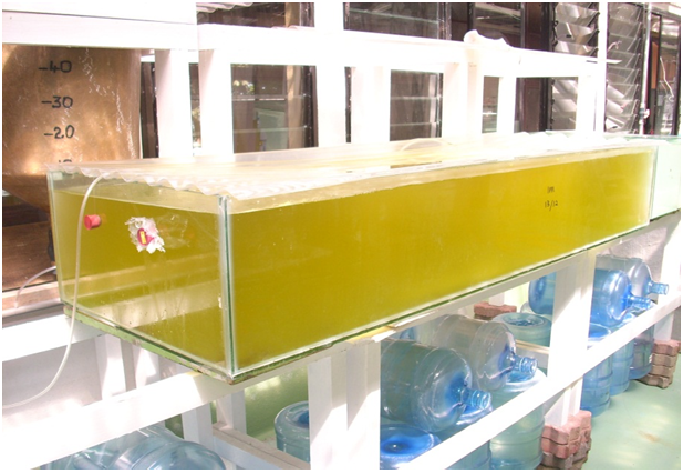
cultured in 300 liters aquarium at semi-open hatchery
-->Isochrysis cultured in 1000 liters tank at semi-open hatchery
Therefore, I decided to culture my microalgae in a closed room equipped with an artificial light, hoping to resolve the aforementioned problems. The results obtained will be compared to the semi-open hatchery culture site as to determine the proper site to produce a better nutritious microalgae. First of all, I needed to get the equipment to set up the lighting system.
Equipment
Quantity
Price/unit (RM)
Actual price (RM)
- 2 x 40W F/L Fitting
8
19.00
152.00
-
Fluorescent tube
16
5.00
80.00
-
Starter S-10
2
13.00
26.00
-
Light dimmer
2
0.50
1.00
- 2 x
40 Metal reflector
8
9.50
78.00
-
Flexible wire
12m
2.60
31.00
TOTAL:
RM 366.00
-->2 x
40W F/L Fitting and Fluorescent tube
Starter
S-10, light dimmer and flexible wire
2 x
40 Metal reflectors
Once the equipments were mounted together, here is the lighting system...
Four fluorescent tubes for each rows (5000 - 6000 Lux)
Light
dimmer installed to control the light intensity
I will update again once the new culture site is fully completed and ready for microalgae culture. See you guys soon!